Library

 Profile
The Labourer Woman
The Labourer Woman

I was forty-two, the manager of a private commercial organisation in a mid-sized city of central India. Far from my hometown, my life had reduced itself to the neat routines of work and the quiet of a small rented flat. The days were predictable, the evenings lonelier than I cared to admit.
Around my office, a new building was coming up. Often, during lunch breaks or in those restless intervals when I needed to stretch my legs, I’d walk out towards the half-built structure. And there, among the dust and cement, I found myself distracted by something—or rather, by someone—who was utterly outside the world I knew.
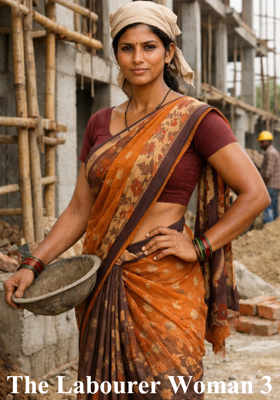
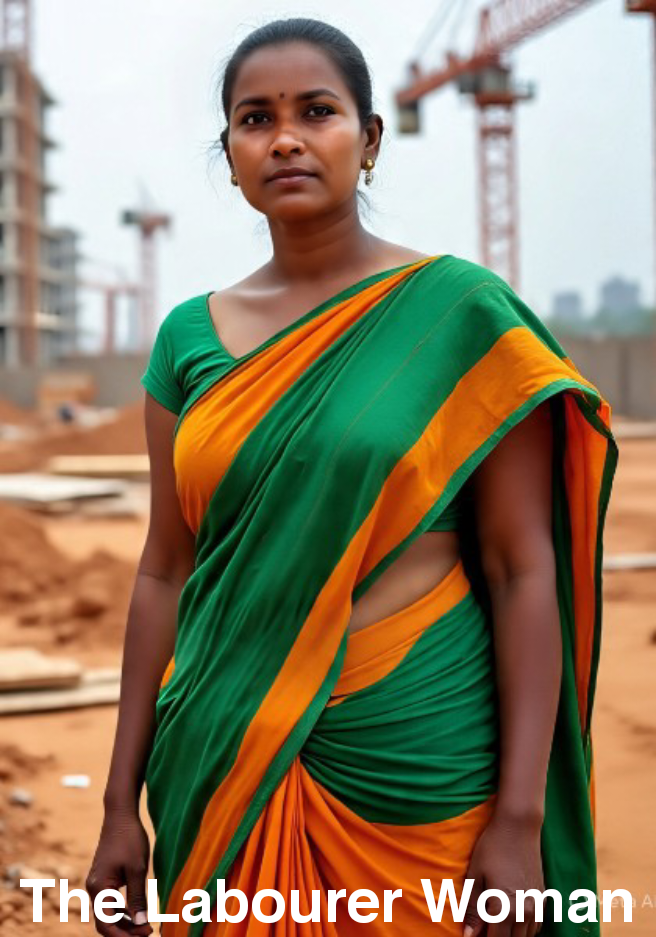
She was a labourer woman. Tall—easily five foot ten—her frame lean but lined with strength, built by years of carrying bricks, balancing water pots, and hauling sacks heavier than I could imagine lifting. Her sari was always tucked roughly for work, faded from too many washes, the ends stained with cement powder. Bangles clinked on her wrists, incongruous against the grit on her skin. Her hair was tied without care, a few strands sticking to her damp forehead.
She was not voluptuous, no softness of curves to draw attention. Instead, her appeal was harsher, commanding: the power of a body honed by survival.
I would find excuses to loiter near her. Sometimes I stood pretending to talk on the phone, sometimes just stretching my back as if casually resting by a wall. What I really wanted was to measure myself against her presence, to stand close enough to feel the difference in height, to feel small before her without anyone noticing.
When she bent to lift a basket of bricks, her shoulders rolled with a raw rhythm that made me acutely aware of my own smaller frame, my tie and polished shoes suddenly ridiculous in comparison. And when, rarely, she straightened and looked around, her face glistening with sweat, her eyes levelled above mine, that simple act of looking up at her made my pulse trip.
I forgot to mention, I have a strange something for tall women. Tall and strong. I myself am quite an average sized man. Five feet three on barefoot and sixty-four kilos or thereabout. What? You think I'm a small guy. Ohk fine.. whatever !
I never spoke to her. Not a word.
But she filled my daydreams. In those private worlds, she was larger than life—sometimes lifting me with casual ease, sometimes cradling me against her chest like one of those loads she carried without thought.
In waking life, I remained nothing more than an observer.
Then one day, she vanished.
The construction continued, men and women came and went, but she was no longer among them. For weeks I looked, my walks growing more frequent, my excuses thinner. But she was gone. And slowly, as always happens, routine swallowed even my longing.
Until one late Saturday afternoon. It was around 4pm.
It was my weekly off, and I was walking to the bazaar for groceries. On the way stood a temple, its steps crowded with the destitute—old men, widows, half-clothed children, all with plates stretched before them. And then I saw her.
She was sitting among them, a steel plate in front of her, her once-commanding frame shrunken by fatigue. The faded sari clung loosely, her face bore new hollows, but the height—the sheer verticality of her—remained. When she rose briefly to adjust her place under a tree, I recognised the figure instantly.
I slowed, my eyes fixed on her, unable to disguise the shock of recognition. She caught me staring. And then, to my surprise, a smile tugged at her lips.
“Kya dekh rahe ho, babu?” she asked, her voice hoarse but laced with amusement. “What are you staring at, Babu?
I stammered, “I—I’ve seen you before. You used to work as a labourer, near my office.”
“Haan,” she said simply, wiping her face with the edge of her pallu. “That job has gone. Contractor lost his contract with the management. We all lost our work.”
The sight of her, once towering and tireless on a construction site, now reduced to this, stung more than I expected. I blurted, almost foolishly, “But why… why are you here, begging?”
She gave a dry laugh. “Babu, it’s easy to say. Nobody gives work. They only give advice and lectures. Will you give me a job in your office?”
The question pricked my pride. “Office mey… tumhare layek koi kaam nahi hai.” I shook my head. “In our office…we don't have any suitable work which you can do.”
“Tab ghar mey de do. Jhaaru, ponchha, khana pakana… sab kar lungi.” She tilted her head, eyes narrowing with mock reproach. “Then give me some work in your home. I can do anything - sweeping, cleaning, cooking.”
I hesitated. “I live alone. How can you work with me?”
“Dekha?” she said, smiling with unexpected mischief. “See? Excuses…”
Her humour startled me. I tried to regain ground. “Fine then. How much do you want?”
She looked straight at me, her expression suddenly stripped of playfulness. “I only need a place to stay. I can’t sleep on the temple floor anymore. Toilets… food… all a problem. You give me shelter, give me food. Baaki jo tumhe sahi lage, de dena. I’m alone, Babu. Whatever you feel like, give me. I don’t have to send money home.”
I looked away, conflicted. The idea of her inside my flat felt dangerous, absurd even. “But I live alone,” I repeated weakly.
She gave a little shrug, her mouth curling again. “Don’t worry. I don’t bite.”
Her sense of humour, sudden and sharp, disarmed me.
I exhaled. “Theek hai. Ok then..Come with me. I’m going to the market. Buy whatever utensils you need… rice, dal, vegetables and whatever you would need for cooking. I usually eat outside. There are no cooking vessels in my place.”
So we walked. She beside me, towering above in her worn sari, barefoot, the bangles faintly clinking as she adjusted her pallu. I became acutely aware of the stares—people glancing at the odd pair we made, a middle-aged manager in neatly pressed clothes, and a tall labourer woman striding by his side.
At the bazaar, I bought utensils, provisions, rice and dal. And then, without letting myself overthink, I bought her three saris too—simple cotton, but clean, bright, something that could restore a little dignity. And a pair of sandals.
She held the bundle easily against her hip, glancing down at me with something unreadable in her eyes. For the first time, it wasn’t me pretending to measure the difference in our heights. It was her very presence reminding me of it.
And I felt, strangely, as though the story I had imagined in secret all those months was only just beginning.
When we returned from the bazaar, the first thing I told her—awkwardly, almost apologetically—was,
“Pehle… naha lo. Clean yourself, have a bath. Then we’ll eat.”
She looked at me, a small flicker in her eyes. Not anger, not shame—just the weariness of someone used to such instructions. She nodded, took the bundle of new sarees, blouse, and that other necessity, the plain cotton petticoat, and disappeared into the bathroom at the far end of the flat.
Through the thin door I heard the splashing of water, the clang of the bucket. I found myself pacing. The thought of her—this tall labourer woman—inside my small tiled bathroom, washing away the grime of weeks, maybe months, unsettled me in ways I could not name.
When she stepped out, the change was startling.
The bright cotton sari I had bought, pale blue with a faded floral border, clung fresh against her dusky skin. The blouse fit tightly across her shoulders, and the petticoat peeped out neatly beneath the folds. She looked taller somehow, her frame straighter without the weight of dirt. Her wet hair was slicked back, a few strands dripping down her neck.
For a moment, I forgot to speak.“Kya babu… pehchaana nahi? Abhi toh bazaar se laaye ho yeh kapde.”
She noticed, half-smiled, and said, “What Babu, what are you looking at like that?…you just bought this saree from the market.”
“Baitho. Tum bhookhi hogi.”
I cleared my throat quickly, embarrassed. “Sit, you must be hungry.”
On the way back I had picked up kachori and jalebi from the bazaar. She sat cross-legged on the floor mat, tearing into the kachori with her long fingers, dipping it into the thin aloo sabzi, the bangles on her wrists clinking softly as she ate.
I sat opposite her on the sofa with my own portion, but my eyes strayed more to her than to the food. There was a hunger in her eating that went beyond appetite. The jalebi she took last, biting into its syrupy coils slowly, eyes closing just for a second as if reclaiming something lost.
“Achha,” I said finally, breaking the silence, “kaise… kaise pohonchi tum yahan? How did you land up here?”
She wiped her mouth with the edge of her new sari pallu, then leaned back against the wall. Her voice was rough, but steady.
“I am from a small village”, she said, “There was a man there, from our very own village. He told me he would take me to the city and get me a job—manual labor in construction. Everything went well at first. We were given a place to sleep at the site at night, and they even provided us with roti and vegetables. The women lived together in a group.”
Her eyes drifted, remembering.
“Then, one day, something went wrong with the contractor's accounts—some financial issue. He lost his contract entirely. The very next day, he sent all of us away. ‘There is no work now’—that is all he said. Since then, I have been sitting here in front of the temple.”
Her words weren’t dramatic. Just plain fact, told the way labourers tell stories—without frills, without begging for pity.
But as she spoke, I felt something gnaw at me. The same woman who had towered over piles of bricks, carrying loads twice my size as if they were nothing, had been reduced to stretching a steel plate on temple steps for coins.
“Tumko… yeh sab nahi karna chahiye tha.” I found myself saying quietly, “You…you shouldn't have done all this.”
“Aur kya karti, babu? Tum jaise log lecture dete ho, par koi kaam nahi deta. Tumne hi toh bola tha—office mein mere layek kaam nahi hai.” She gave me a look, almost amused. “What else could I have done, Babu? People like you give lectures but offer no help. You only said—there is no suitable work for me in the office.”
Her words stung again, though not cruelly—just truth.
She reached for another jalebi, holding it delicately despite the strength in her fingers, and popped it into her mouth. The sugar stuck to her lips. She licked it off, casual, unbothered, as if she had eaten this way all her life.
And for the first time in years, sitting across from her, I felt that my flat was no longer entirely my own. It had already begun to stretch and shift to fit the presence of this woman, taller, stronger, rawer than anyone I had ever allowed into my private space.
When we finished the kachori and jalebi, I cleared the paper plates into the bin. She sat for a moment longer, stretching her long legs out, leaning back against the wall as if claiming her space already.
I hesitated, then said, “Look… this flat isn't big. There are only two rooms—my bedroom and a living room. The kitchen, bathroom, and balcony are quite small.”
She nodded, listening.
I said, "I have an extra mattress... I've got extra sheets and pillows too. If you need to rest during the day and for your sleeping at night, just lay it out on the living room floor.”
I said it matter-of-factly, trying to sound firm, but something in me was nervous—like I was laying down rules for a guest who, in truth, didn’t really feel like a guest.
She looked around, eyes sweeping over the small drawing room. The teakwood cot in my bedroom was visible through the half-open door, the AC unit humming softly above it. The drawing room had a sofa set; a small dining table with two chairs; and a Television, nothing much.
“Yeh kafi hai babu. Zameen pe sone ki aadat hai. Ghar bhi wahi ban jaata tha jahan sham ko site pe kaam khatam hota tha.” She smiled faintly, then said with that same dry humour, “This is more than enough, Babu. I’m used to sleeping on the ground. My home used to be wherever our work on the site ended for the evening.”
Her words had no complaint in them. In fact, there was a kind of pride—an ease with hard ground and temporary roofs.
Still, as she walked into the bedroom doorway, her tall figure seemed almost too large for the small AC room. She bent slightly, checking out the neat bed I kept for myself, the wardrobe, the single framed photo on the wall. Her presence filled the space, her shadow stretching across my modest world like she had always belonged.
Back in the living room, she spread the spare mattress with the ease of someone who had done this a thousand times before. The sheet stretched crisp, the pillow plopped at the top. Then she sat cross-legged on it, adjusting her sari, her bangles chiming softly in the quiet flat.
“Bas babu… ab lag raha hai ghar jaisa. Pehli raat hai, kal subah main khud hi kitchen dekh lungi.” Looking up at me, she said, "That’s it, Babu... now it finally feels like home. It’s the first night. Tomorrow morning, I’ll take care of the kitchen myself.”
I nodded, though something inside me twisted. A part of me felt relief—she had a corner of her own now. Another part felt strangely unsettled—my private little flat, so carefully kept, was already reshaping around her height, her presence, her easy claim on space.
That night, lying in my own bedroom, AC humming, I could hear faint sounds from the drawing room—the rustle of her saree pallu as she shifted, once or twice a sigh. And I thought, almost against my will, a labourer woman, 5’10” tall, sleeping just on the other side of this wall in my flat…
Sleep came slowly.
That Sunday morning had a strange sweetness to it. The kind I can’t really explain, but I feel it in small details—like the sound of the kettle bubbling on the stove, or the faint smell of soap still clinging to her hair after the bath I’d insisted on yesterday.
She moved about the kitchen with an awkward kind of grace. Not polished like someone used to running a household, but steady, practiced in survival. The clinking of cups, the sound of the steel plates, her bangles faintly jingling—it gave the flat a new rhythm.
When she brought the tray to the living room, she didn’t try to sit beside me on the sofa. Instead, she quietly folded herself onto her mattress spread on the floor, cross-legged. I sat above, on the sofa, the fan whirring overhead, looking at her from that angle. It struck me again—how tall she was. Even sitting down, her back straight, she seemed to stretch upward in a way I never could.
We both had chai and simple breakfast, the toast-butter and boiled eggs finishing quickly. She ate with quiet hunger, but also a surprising neatness, as though even after days on the pavement she carried some pride in her movements.
“I didn't ask your name yet?” I asked softly, finally breaking the silence.
She hesitated, as though her name was something fragile. “Shanti,” she said.
The word hung in the air. Peace. I looked at her, this woman who had lost so much, yet sat before me in a clean saree, hair tied back, looking almost dignified despite everything.
The day stretched lazily. I had nowhere to go, and she had nowhere to be. She busied herself with small tasks—washing the plates, sweeping the corner of the kitchen without me asking. Then she settled back on her mattress, her tall frame half-reclining, her long arms stretched behind her head. She looked oddly at home there, and I felt a stirring—both protective and strangely restless.
At one point, I switched on the TV, some Sunday movie playing. She didn’t follow much, but her eyes stayed fixed on the screen, wide, curious. I found myself watching her more than the film—the way she leaned forward at the songs, the way her lips parted slightly in surprise when a heroine in glittering clothes spun across the screen.
By afternoon, the flat felt different. Lived in. Not silent and sterile as it usually did on Sundays. There was another breathing presence now, a woman whose story still hung unfinished in the air. Simple, homely, yet it felt different having someone move around in my little flat. We sat in the living room—me on the sofa, she on the mattress she had spread out on the floor. Fortunately, the fan was strong, so the room stayed cool enough.
The day passed in small movements. She cooked lunch too. I had a small dining table, just for two. I told her she could sit with me and eat. She only smiled and said softly that she would eat later, after I had finished, and that too on the floor. I didn’t press her. Something about her tone made it clear—it was her way.
All day, moving about that cramped 1 BHK—bedroom, living room, tiny kitchen, balcony—we crossed each other often. Every time I brushed past her, I felt a strange excitement. Her height towered over me in those narrow spaces, reminding me of something I couldn’t ignore. We didn’t speak much. It was awkward, yes, but her presence filled every corner of that flat.
In the afternoon, she rested on her mattress in the drawing room. I lay down in my bedroom. The flat was quiet except for the faint hum of the AC and the muted sounds from outside—the occasional honk, the cries of vendors.
At five, she made tea again. This time, I brought out my biscuit dabba. I sat on the couch, she stayed on her mattress, serving me with that same simple grace. For a while, we just sipped quietly. Then something stirred in me, and before I could stop myself, I spoke.
“You’re tall… really tall,” I said, looking at her across the room.
Her eyes lifted, surprised, then softened. A shy, amused smile tugged at her lips. “Gaon mein bhi sab kehte thhey. Bachpan se hi sab se lambi thi.” She replied, her voice low and a little hesitant, “Everyone in the village said it too. I was the tallest for my age from childhood.”
I chuckled. “I feel that whenever I pass by you... the entire sky just gets covered.”
She laughed at that—an unpolished, honest laugh. She even covered her mouth with her saree pallu, shoulders shaking, eyes glinting with something lighter than the day’s heaviness.
But I wasn’t joking. Each time I had crossed her in the small kitchen or corridor, her tall frame had pressed on me. Even now, though she sat cross-legged on the floor and I was on the sofa, she seemed somehow larger, more present.
“Aap chhote hain… isiliye lagta hai aisa.” She caught me staring and shook her head gently. “You are small... that is why you feel that way.”
The words made me blush, but they didn’t sting. Her tone wasn’t mocking. It was simple truth, offered without malice. Almost like acceptance.
And suddenly, the silence between us wasn’t heavy anymore. It had become something else—softer, almost warm.
After tea, the hours drifted lazily. I read the newspaper for a while, she folded away some clothes, swept a corner of the floor with a small broom she had bought in the bazar. The light outside began to change—golden at first, then slowly dimming into the soft blue of dusk.
By habit, I stepped out onto the narrow balcony. It wasn’t much—just enough space for two people to stand side by side, with a railing that looked out over the busy street below. A few scooters, rickshaws, the smell of frying pakoras wafting up from a stall, temple bells ringing in the distance.
I was leaning on the railing, watching people come and go, when I sensed her behind me. Without a word, she stepped out too. She had washed her face and combed her hair after finishing the chores, and she smelled faintly of soap and the fresh cotton of her new saree.
The balcony suddenly felt smaller with her there. She came and stood right beside me, her elbow resting easily on the railing.
And just like that, the comparison happened. I didn’t even have to try.
Her shoulder was well above mine. Her frame seemed to close around me, as though I had shrunk without warning. My eyes reached only to the side of her neck. I tilted my head up slightly to look at her profile—the strong jawline, the tired but steady eyes looking out over the street.
I felt that familiar testosterone rush. The same childlike thrill I used to feel months ago when I lingered near her at the construction site. That secret excitement of being the smaller one, of being swallowed in some woman’s height and presence.
I pretended to focus on the traffic below, but my heart was racing. She caught me stealing glances.
“Kya dekh rahe ho babu?” she asked softly, not with her earlier teasing smile, but something gentler. “Why are you looking at me, Babu ?”
I swallowed, “Bas…It’s just… I feel like I become even smaller when I stand next to you.”
“Chhote toh waise bhi ho… ab lagta hai aur zyada mehsoos karte ho.” She turned her face toward me then, really looked. For a moment her eyes searched mine, and then she gave a quiet laugh—low, almost husky. “You were small anyway... but now, it seems like you are feeling things even more deeply.”
Her words should have embarrassed me, but instead, they warmed me. Because she wasn’t mocking. She was simply stating the truth as she saw it.
We stood like that for a long while. Not talking, just side by side. I could hear the rhythmic rise and fall of her breath, feel the warmth of her arm so close to mine. Down below, life went on—vendors shouting, bells ringing—but up there, in that small balcony, time seemed to pause.
And for the first time in months of daydreams, I wasn’t just imagining the comparison. I was living it.
We lingered on the balcony as the sun slid lower, the air turning cooler, softer. The traffic noise rose and fell like waves. I leaned into the railing, arms folded, my body unconsciously angling toward her. She, meanwhile, stood tall and easy, as if the whole city stretched comfortably beneath her gaze.
After a silence, I asked, “Tumhari umar kitni hogi?”
“Pata nahi babu… 41 ya 42. Mujhe khud dekhna padega Aadhar card mein.” She gave a shrug, one bangle sliding down her wrist. “I don't know, Babu... 41 or 42. I'll have to check my Aadhaar card for that.
I laughed lightly. “Ohh… toh you’re almost my age. I'm 42. Main 42 ka hoon.”
“Phir bhi aap toh bacche jaise lagte ho. Chhote bhi ho, aur nazar bhi aisi maasoom hai.” She turned her head, looked down at me with a half-smile. “Even then, you look just like a little boy beside me. You are so short, and your gaze is also so innocent.”
Her words sank deep. The contrast pressed itself into me—the same age, yet standing beside her, I felt so small, like a boy caught next to an unshakable grown-up. I didn’t even argue. I just let the truth sit there between us.
The streetlights blinked on. I shivered a little as a breeze passed through the balcony. She noticed. “Chaliye andar. Thoda thand ho rahi hai.” “Let's go inside. It's getting a bit cold.”
Inside, she busied herself in the kitchen, moving with new energy. I hovered nearby, pretending to straighten things, but really just watching her—how easily her long arms reached the higher shelves, how firmly she lifted the water bucket and set it near the stove.
Then it happened.
I had bought a large sack of rice in the bazaar a few days back, planning that I would portion it out into containers. It was sitting near the kitchen door, heavier than I realized. She tugged it once and laughed. “Arre babu, yeh toh kaafi bhaari hai. Aap ne kaise utha liya?” "Oh Babu, this is quite heavy! How did you manage to lift it?”
“Ohh I had asked the rickshaw walla to bring it up for me,” I muttered, embarrassed.
She bent down and, without much effort, hoisted the entire sack against her hip, as if it were no more than a bundle of clothes. My jaw slackened.
But as she adjusted its weight, she looked at me, eyes amused. “Container kahan hai? Dikhaiye.”
I hurried toward the cupboard, pulled one out from the bottom shelf. As I did, she said casually, “Rukiye… idhar dijiye. Aur aap side ho jaiye, warna gir jaayenge.” “Wait... hand it over here. And step aside, otherwise you'll fall.”
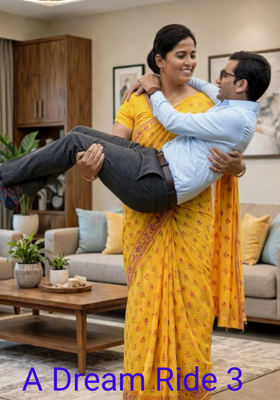
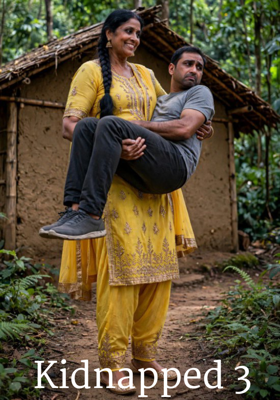
I stepped aside—but the shelf was awkwardly low, and she had one hand full with the sack. Without a word, she nudged me slightly forward, then suddenly bent, looped her free arm around my waist, and lifted me up—just enough so I could place the container on the higher counter.
For a moment, I froze. Her strength was shocking. I was off the ground, my body pressed lightly against her side, her arm firm around me.
My breath caught. The world tilted.
By the time my feet touched the floor again, the container was on the counter and she was already pouring rice, unfazed.
But I stood there, pulse racing, pretending to brush my kurta straight. That first taste of being lifted—so casual, so matter-of-fact—was enough to burn the entire evening into memory.
“Kya hua? Dar gaye kya?” She looked at me once, eyebrows raised. “What happened? Did you get scared?”
I shook my head quickly, though my ears felt hot. “No, not that… bas… it was so sudden!”
“Arre babu, ghar ka kaam hai. Kabhi kabhi uthaana padta hai.” She chuckled. "Oh, Babu, it's household work. Sometimes I'll have to lift things.”
I smiled weakly, but inside, the smallness, the thrill, the testosterone rush—it was all alive, all consuming.
My daydreams may ultimately come alive…