Library

 Profile
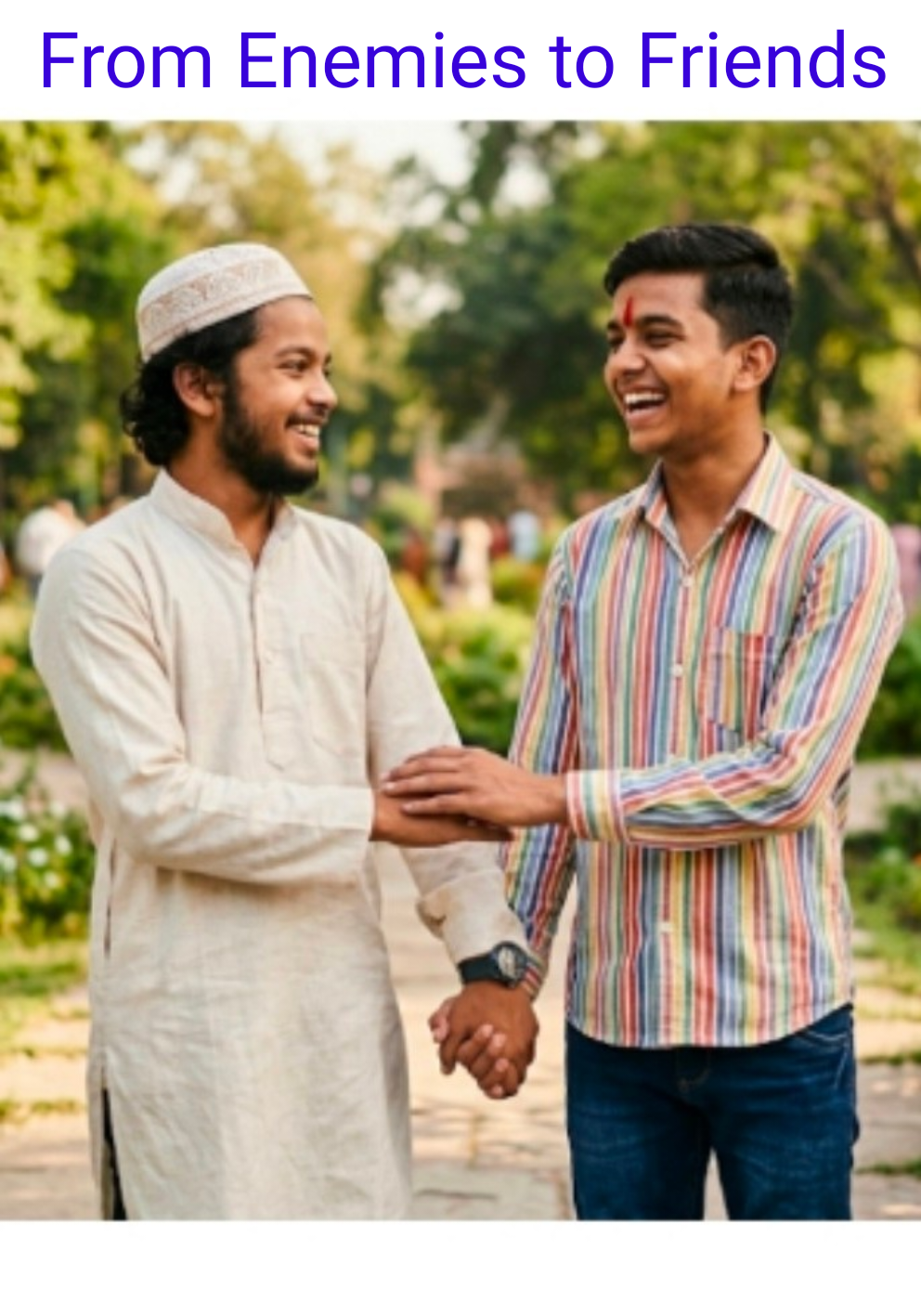
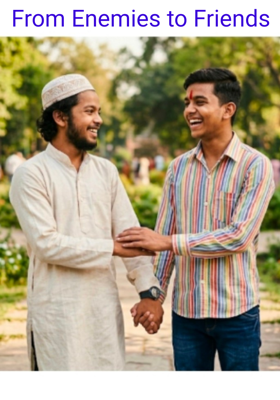
From Enemies to Friends
From Enemies to Friends

Ritwik Chatterjee had always believed that anger was a form of strength. It gave him a sense of purpose, a sharp edge in a world he felt had wronged him. Sitting in his small room in Bhubaneswar, his phone glowing in the dim light, he typed furiously.
“Islam has done nothing but spread hatred and fear.It is a cult.A criminal cult.” he posted. “Wake up before it’s too late.”
Within minutes, the comments began pouring in—some radical Hindus strongly agreeing, many radical Muslims venting anger and fury, and a few threatening kill him. Ritwik thrived on it. Each argument, each insult, seemed to justify his bitterness. He had never met a Muslim closely, never shared a meal or a conversation, yet his mind was filled with potential fears and all the negative ugly things about Islam and Muslims.
Among the hundreds of replies that night, one stood out.
A user named Raghav Sharma wrote calmly, “You’re brave to say this openly. Most people are afraid. Truth needs courage for expression.”
Ritwik smirked.
Finally, someone who had understood his sane opinions about Islam.
Over the next few weeks, Raghav became a constant presence. He supported Ritwik’s posts, shared even harsher critiques of Islam, and gradually moved the conversation into private messages.
“You think deeply,” Raghav wrote one night.
“Most people don’t question like you do.”
Ritwik felt seen. Encouraged.
“People are blind,” Ritwik replied. “They follow without thinking.
”
Raghav responded, “Exactly. Religion has become a tool in the hands of manipulators.”
That line struck Ritwik. It echoed something he had felt but never clearly expressed it.
Their conversations grew longer, more intense. Politics, religion, history—nothing was off limits. Raghav often pushed the arguments further, testing Ritwik’s convictions.
“Would you be willing to meet?” Raghav asked one day. “Face-to-face discussions are better.”
Ritwik hesitated. Then curiosity won.
“Where?”
“Kolkata.”
Kolkata was a city of contradictions—colonial buildings beside crumbling alleys, temples beside mosques, chaos and calm intertwined. Ritwik arrived with a mix of excitement and unease.
They agreed to meet near Howrah Bridge.
When Ritwik spotted him, he was surprised. Raghav didn’t look like the aggressive, fiery person he had imagined. He was quiet, observant, almost gentle.
“You’re Ritwik?” he asked.
“Yes. And you’re Raghav.”
The man smiled faintly.
“Not exactly.”
They walked in silence for a while before stopping at a tea stall. The air smelled of chai and diesel.
“My real name,” he said slowly, “is Saim Mohammad.”
Ritwik froze.
For a moment, anger surged. “You lied to me.”
“Yes,” Saim replied calmly. “Because if I had told you the truth, you would never have spoken to me.”
Ritwik clenched his fists.
“So this was a trap?”
Saim shook his head. “No. It was an experiment. I wanted to understand how someone like you thinks.”
“And what do you think now?” Ritwik demanded.
Saim looked directly at him. “I think you’re not as hateful as your words.”
The statement disarmed him.
“And you?” Ritwik shot back.
“You’ve been pretending to hate your own religion.”
Saim exhaled. “Not pretending. I have my own anger too. I’ve been taught that people like you are enemies. That you must be stopped.”
“Stopped?” Ritwik asked, narrowing his eyes.
Saim didn’t answer immediately. Instead, he said, “Come with me.”
They reached a small, rented room in a narrow lane. It was bare except for a bed, a table, and a locked trunk.
Saim opened the trunk.
Inside were knives, a pistol, and a few crude explosives.
Ritwik stepped back instinctively.
“What is this?”
“My plan,” Saim said quietly.
“To kill someone like you.”
The words hung heavy in the air.
“Then why didn’t you?” Ritwik asked.
Saim looked conflicted.
“Because the more I spoke to you, the more confused I became.”
Silence stretched between them.
Ritwik slowly sat down. “You know what’s strange?” he said. “I came here thinking I’d meet someone who would confirm my beliefs. But now… I don’t even know what to think.”
Saim closed the trunk. “Neither do I.”
That night, they talked.
Not as enemies, not as representatives of religions, but as two young men trying to make sense of a complicated world.
“Who told you all this?” Saim asked. “About Muslims being enemies?”
“Family, social media, certain speakers,” Ritwik admitted.
“And you?”
“Some preachers,” Saim said. “Online groups. They said it’s my duty to fight.”
“And you believed them?”
“Yes. Completely.”
Ritwik leaned forward.
“Did you ever question them?”
Saim hesitated. “No. Questioning was seen as weakness.”
Ritwik laughed bitterly.
“Same here. If you question, you’re called a traitor.”
They both fell silent again, realizing the strange symmetry.
“Isn’t it odd,” Ritwik said slowly, “that we were both taught to hate each other by people who never asked us to think?”
Saim nodded.
“Maybe,” he said, “the problem isn’t just religion… but how it’s taught.”
Over the next few days, their discussions deepened.
They visited libraries, read texts, watched debates, and even attended both a temple discourse and a mosque sermon.
In both places, they noticed something unsettling.
Certain pandits spoke with authority, discouraging questions, emphasizing fear and division. Certain maulanas did the same, using emotional rhetoric to create an “us versus them” mindset.
“Different words,” Ritwik observed, “same method.”
Saim nodded.
“Control.”
They began questioning everything—rituals, interpretations, and the authority of those who claimed to speak for God.
“Do you really think God belongs to one group?” Ritwik asked one evening by the Hooghly River.
Saim shook his head. “If God is infinite, how can He be limited to one name or one path?”
Ritwik smiled faintly. “Exactly.”
For the first time, they felt a sense of clarity.
“The Almighty is one,” Saim said, “but we’ve divided Him into pieces.”
“And then fought over those pieces,” Ritwik added.
Their transformation wasn’t sudden. It came through discomfort, arguments, and long hours of introspection.
There were moments when old prejudices resurfaced, when they almost walked away. But something kept them grounded—the realization that they were both victims of the same conditioning.
“We were taught what to think,” Ritwik said, “not how to think.”
Saim replied, “And that made us dangerous.”
One morning, Saim brought out the trunk again.
“This has to go,” he said.
Ritwik nodded.
Together, they dismantled the weapons, discarding them piece by piece.
It felt symbolic—like shedding layers of ignorance.
“I almost used these,” Saim said quietly.
“But you didn’t,” Ritwik replied.
“That matters.”
They decided to do something unexpected.
Instead of arguing online, they would speak to people directly.
They started small—tea stalls, college campuses, street corners.
At first, people ignored them. Some mocked them.
But gradually, a few began to listen.
“We’re not here to tell you what to believe,” Ritwik would say. “We’re here to ask you to think.”
Saim would add, “Don’t accept anything blindly—not from pandits, not from maulanas, not from us.”
They spoke about their journey—the anger, the deception, the realization.
They emphasized a simple idea:
“We all come from the same source. The names may differ, but the essence is one.”
Some people resisted.
Others were curious.
A young boy once asked, “So are you saying religion is wrong?”
Ritwik paused before answering. “Not necessarily. But blind belief is dangerous.”
Saim added, “And so is blind rejection. What matters is understanding.”
Their message evolved over time.
They began speaking about what they called “spiritual science”—the idea that truth should be explored through experience, reason, and introspection, not imposed through fear.
“Religion should connect,” Ritwik said during one gathering, “not divide.”
“And spirituality,” Saim added, “should liberate, not control.”
They were careful not to insult anyone’s faith directly. Instead, they challenged the misuse of faith.
“Respect your tradition,” Ritwik would say, “but don’t let anyone use it to manipulate you.”
Saim would echo, “True faith doesn’t fear questions."
Months passed.
Their journey took them beyond Kolkata—to villages, towns, and cities.
They faced hostility at times. A few religious leaders warned people against them.
“These boys are dangerous,” one pandit declared.
“They are misleading the youth,” a maulana said.
Ritwik smiled when he heard this. “Looks like we’re doing something right.”
Saim chuckled. “Or something very wrong.”
But deep down, they knew they were walking a difficult but necessary path.
One evening, as they sat under a quiet sky, Ritwik asked, “Do you ever regret it?”
“What?”
“Meeting me.”
Saim thought for a moment.
“No,” he said. “Because I didn’t just meet you.
I met myself.”
Ritwik nodded. “Same.”
They sat in silence, watching the stars.
“So many,” Ritwik said, “yet part of one universe.”
Saim smiled. “Just like us.”
Their story didn’t end with a grand conclusion. There was no sudden transformation of society, no universal acceptance.
But wherever they went, they left behind a seed—a question, a doubt, a spark of curiosity.
And sometimes, that was enough.
Because change, they had learned, doesn’t begin with shouting.
It begins with thinking.
And perhaps, just perhaps, with the courage to see the other not as an enemy—but as a reflection of one's own self.