Library

 Profile

Memories Of My First Day Of ..
Memories Of My First Day Of ..

My school was situated in a typical small village, near to my home. It was hardly five minutes’ walk from my home to the school, but we( my elder brother and me) took always not less than ten minutes to reach the school. We would leave our homes early so that we could have different experiences on each day, during the short journey. We spent time watching birds on trees, reptiles on railings and other animals on the way. Sometimes we used to chat with our friends in the neighborhood, who were getting ready to come with us. We used to wait for them, unless we were late. If we were lucky, we could see dancing peacocks also, on the road.
There was a huge Banyan tree in front of the temple, adjacent to our home and on the way to school. Wire-type trunks of the tree falling from the top to the ground were used as our swings. Clinging to them with our entire mite and swinging to and fro, was our hobby, whenever we got time. When we are forced ourselves to oscillate, we looked like pendulum of a clock. The movement of leaves of the Banyan tree made rhythmic music, when the wind blew, which made us happy. It was an oasis for the passers-by, who were moving with head-loads and used to take rest for some time, unloading the goods, on the plinth of the tree. It was a shelter for the wandering beggars, during the hot summer months.
As a child, it was dreadful to see the owls sitting on its branches, making awful sounds. Beautiful woodpeckers, with multiple colors, sitting on other trees nearby, were struggling to make their nests. The red colors of their heads, made us feel, that they were wearing red hats made of fur. The voice of cuckoos sitting on the banyan tree was very melodious. We, as children, repeated the same sound it produced and the whole atmosphere blended with echoes.
The road to the school was very rough with thick with red mud. Daily walking on those roads made some mud to look like stones with sharp edges. It was never maintained well, by the village authorities. The flow of rainwater through the roads, during monsoon, made the condition of the road, still worse. There was every chance of fall while running through this road. If fallen, there was no way to stop the profuse bleeding from your knees, but to wait till the time it clots, on its own. But we enjoyed the village life to its maximum, during school days.
There was a public well on the way to school. Anybody was free to draw water from it. Ladies from the surrounding homes, where there were no well, used to draw water, from this well for their daily use. A three-foot-high, brick and cement structure was constructed at the periphery of the well, exactly round in shape as the well itself, to prevent anyone from falling into it. Water was available in the well all the twelve months. It was a daily scene to see unemployed youths sitting on the wall chatting for long. When we reached near the well, it was always a tendency to look into the well deep so that we could see our faces, in the water, as an image. It was as if we were taking a selfie from a smartphone, in the present age.
Going to school on the first day, was never a happy affair for many students. Like all other children, I was also a little hesitant to go, thinking that I won’t get enough time to play in the home, as before. It was on June 1st,1960 that I began my journey as a student of 1st Standard. As my elder brother was also studying in the same school in Standard three, my mother did not come with us to the school on my first day. The school timings were from 10 am to 4 pm.
In those days (the early 1960s) every child used to come to the school by walking. That first day, I carried only a black slate and a pencil ( made from Natural Lime Stone ). The writings on the slate can easily be removed by a wet sponge, just as we use for currency note counting in a bank, We never carried any water bottles nor a load of books. Whenever we felt thirsty, we used to drink water from the well, of the school compound. There was no school bus or any auto to ferry the students from individual homes to the school. Those who had even a bicycle were considered affluent in society.
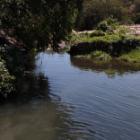
We had to cross a canal on the way. There was knee-deep water during most of the months. Water from the dam, situated about twenty kilometers away, was released for irrigation purpose during winter and summer seasons. But in the monsoon months, when the water level in the dam was about to reach the maximum level, water authorities used to release excess quantity of water, to maintain the optimum level. The released water directly came to the canal, raising the level of water, many a time, forcing us to use the bridge built over the canal, which otherwise not used, as it was not our preferred route. We enjoyed crossing through the canal. Water would be crystal clear in those monsoon days.
Our school was an L-shaped hall with many entrances with half-built walls in between, which served as window slots. Every classroom was separated by movable wall type structures, made out from bamboo stems. The roof was made up of wooden structure with tiles laid at the top, in a uniform manner. There were no pillars throughout the length of the structure. The architecture of the roof was unique. The wooden structure was built in such a way that it would never fall, because all of them were connected together, just like in scaffolding. There were neither doors nor windows fixed to the school building. There was a big gate at the entrance.
The students were made to sit in the strong wooden benches, while a table and chair were provided to the class teacher. Since there was no electricity connection in the area, we had to depend on nature to get a good breeze. But there was good ventilation and enough natural light, as the rear end was completely connected all together with brick structures up to a height of around four feet. When it rained combined with wind, sprinkles of water droplets made those students wet, who was seated near the window slots.
I was also just about to cry when my brother left me in my allotted class before going to his class. The case was no different for other students, but the teacher was matured and trained enough to face such difficult situations. When the bell rang at 10.00 am, every student was asked to assemble at the school compound. When all students were made to stand properly, leaving sufficient spaces in between, a prayer on Saraswati Vandana was rendered by a dedicated team of senior students. Soon after, everybody was taken to their class, in a line, by the individual teachers.
Our class teacher was a middle-aged lady, named Sarojadevi, dressed in a white cotton saree with an elegant look, but without spectacles. Our class teacher came to the class carrying with her a cane, a pair of colored chalks and a list of students who had taken admission to standard I. As soon as she entered the class, we all stopped talking suddenly. She sat for a while in her chair and told each one of us to stand once when their name was announced. She took out the chart and started calling the names from the list one by one. The list was tabulated in alphabetic order. After the process, she counted our heads to make sure that all were present as per the list. We were forty in numbers altogether.
A blackboard was fixed in the corner of the class, on a stand with three flat pillars made of wood, two at the front and the third at the back. The pillar at the back was adjustable since it was fixed at the top with hinges. The board looked like a drawing board as used by an artist. She wrote down “Standard I, Division A”, at the left-hand top corner of the board, and “Strength 40, Present 40” at the right-hand top corner of the board. We could understand at later years that it was mandatory to write and update these data each day as per the Govt. rules.
The teacher told all of us to draw pictures of any animal in the slates, we had carried. We all tried to draw something and she came and saw the drawings each one of us made. Then she announced that she will draw a picture of an elephant on the blackboard. Everyone was very eager to see her drawing with the coloured chalks. Most of the students had seen an elephant in our village itself, because during festivals, elephants were an integral part. After the festivals, elephants were used to lift huge timbers, in place of a crane. The picture of the elephant drawn by the teacher, made us very curious, as it looked like the original.
Then she wrote three letters of the English Alphabets A, B, and C on the board and asked all of us to repeat what she told. She pronounced each alphabet in her maximum voice, pointing the cane towards each, giving us time to repeat every time. We all did what was expected of us. The entire class echoed our sound, continued our first learning for almost an hour.
It was nearing 12.00 noon. Mid-day meal was served in our school. The aroma of boiled rice and dal had filled the air with intermittent smokes. Ramu was the main chef at the school kitchen, while his family members helped him often to bring water for cleaning the vessel and providing him with big tamarind cut-wood for cooking. The wood was used as the fuel for cooking food in large quantities for the children. Many students had brought the plate and spoon with them, but I did not, as my intention was to go to my home for lunch.
Exactly at 12.30, the school peon rang the bell for lunch break. Students ran out to wash their hands, near the school well, as a preparation for the lunch. By the time, my brother came to my class and both of us ran to our home and ate lunch. After some time, we had again come back to our school.
At 1.30 pm, soon after the peon rang the bell, those who were in the playground in the school premises, came running to their classes. After a few minutes, the same teacher came back and counted our heads again and confirmed nobody was missing in the class. She started telling stories to us about animals and birds and we listened to them with much eagerness.
After some time, she offered us one chocolate each and we were happy eating them. She took all of us to the playground in a line and all of us sat in round, under a tree. She started singing rhymes for children. She instructed all of us to clap our hands in tandem with the songs. We all clapped, but in a different rhythm altogether. Then, we were asked to form two groups among ourselves and to play the throw ball.
Those of who were interested were asked to run 100 meters race. The tall and well-built, among us tried their luck to come first in the race. Those who came first, second and third were given chocolate as a prize.
Suddenly dark clouds appeared from nowhere and the whole atmosphere looked different. As Sun was not seen in the dark clouds, it was getting dark. When the drizzling started, all of us were asked to go to the class. We all went running to our class. There were lightning and thunders. It rained for an hour and we just remained inside the class, doing nothing. It was almost 3.45 pm then. At 3.50 pm, peon rang a bell. The teacher asked all of us to come in line and stand in the veranda of the school. Students from other classes also lined up before their class. I did not know why we were made to stand instead of allowing going to our homes. Soon all the teachers came out of their class to the veranda, the same senior students seen in the morning rendered the National Anthem. It was 4 pm by then. In the end, the peon rang a continuous bell, by which we all knew that the day is over in the school. Everybody took out their belongings and ran towards their home. After reaching home, I narrated the complete happenings of the day, to my mother, who listened to everything. It is still nostalgia for me, as to how I started my learning from school.