Library

 Profile
Shiva — Beyond Myth, Mind, and Matter
Shiva — Beyond Myth, Mind, and Matter

Volume 1: Beyond Stories — Science, Void, and Cosmic Physics.
Chapter 1: The Stories We Were Told vs. The Science They Kept.
If you grow up listening to ancient Indian stories without questioning them, it is very easy to get confused. People read the Puranas literally and end up debating why a god has two wives, why deities fight among themselves, or why someone’s head was replaced with an elephant’s. Over time, these literal interpretations made people caricature complex philosophies into simple fairy tales, or worse, mock them entirely.
Sanatana Dharma was never meant to be taken at surface level. Ancient sages knew that raw, abstract cosmic truths are hard for the human mind to grasp. You cannot teach advanced theoretical science to a child without using a simple story first. If you want to teach a kid basic math, you do not throw calculus at them; you give them two chocolates, take one away, and show them what remains.
The Puranas were those initial chocolates. They wrapped deep cosmic mechanics, neurobiology, and psychological truths inside memorable stories so they could survive across generations.
Take the story of the Ocean of Milk, the Samudra Manthan. On the surface, it sounds like a fantasy tale about gods and demons pulling a massive snake around a mountain to churn an ocean. But look closer at what it is actually saying. The ocean of milk represents human consciousness and the vast Milky Way galaxy. The churning represents the deep internal work every human goes through in life.
Notice what comes out of the ocean first. It is not the sweet nectar of immortality (Amrit). It is Halahala, the lethal poison.
That is how life works. Before you reach wisdom, clarity, or peace, your mind inevitably churns out all your stored negativity, fears, and toxic patterns. Shiva swallowing that poison and holding it in his throat without spitting it out or swallowing it down is a masterclass in emotional awareness. He neutralizes the poison at the throat level (Vishuddhi Chakra). He shows us that master consciousness neither spews negativity onto the world nor lets it pollute the inner self.
The same principle applies when people joke about Shiva having two wives, Ganga on his head and Parvati by his side. It was never a story about celestial bigamy. Ganga represents Jnana, the flow of higher intellect pouring out from the peak of human consciousness. Parvati represents Shakti, the physical energy of the universe living right beside consciousness.
Look at the birth of their children. Parvati creates Ganesha from the earth and elements of her own body, symbolizing physical matter (Prakriti). When Shiva places the elephant head on him, it symbolizes supreme intellect (Buddhi) overriding ego. On the other hand, Murugan is born directly from the fiery sparks of Shiva's third eye—representing pure, sharp wisdom (Jnana) and focused courage born straight out of elevated consciousness.
When you strip away the literal folklore and look at the design behind it, you realize these stories were never meant to bind us to blind belief. They were designed to wake us up.
Chapter 2: Cosmic Physics, Brainwaves, and the Liberty to Question
.
One of the most remarkable aspects of Sanatana Dharma is its magnanimity. It was not revealed in a single day, nor was it dictated by a single book or prophet. It evolved organically across millennia, absorbing life’s realities, adapting to changing eras, and encouraging seekers to question everything. In this philosophy, asking questions is not seen as disrespect or heresy; it is viewed as the very engine of spiritual growth.
This inherent liberty is why modern creators, artists, contemporary authors like Amish Tripathi, and even modern pop and rock musicians can reimagine Shiva in new narrative and musical lights. Today, pop singers take the high-energy rhythm of the Shiva Tandava Stotram and turn it into viral anthems because Shiva's energy is timeless and dynamic. Sanatana Dharma grants you the freedom of expression because Shiva isn't a fragile dogma that shatters when scrutinized. He represents an all-encompassing, evolving consciousness that welcomes every genuine inquiry. You are given mapped paths by ancient seers so you can travel safely through life without getting lost in the dense wilderness of ego, but you are never forced. You are always given the freedom to experience the truth firsthand.
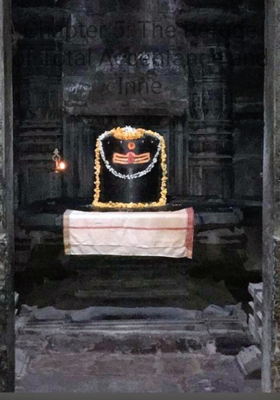
This journey from external tools to internal experience is why we start with idol worship, but as our understanding matures, the form dissolves into something vast and boundless. Shiva is represented not merely as a human persona, but as the Lingam—an infinite pillar of light with no visible beginning (Aadhi) or end (Aantham). The Lingodbhava story illustrates that neither Brahma (intellect/creation) nor Vishnu (preservation/ego) could measure the boundaries of this infinite light.
Tamil Siddhar literature similarly emphasizes moving beyond external ritualism toward direct self-realization. As the famous Siddhar verse asks: "Why do you circle a planted stone, offering flowers and whispering mantras? Will a planted stone speak when the Divine resides within you?" Idol worship is an initial step—a focus point for the mind—but Shiva philosophy ultimately urges the seeker to recognize that the supreme sanctuary resides within one's own consciousness.
In places like Amarnath, this pillar of light manifests naturally as an ice Lingam formed purely by frozen water drops that wax and wane with the lunar cycle—a stark reminder that nature itself spontaneously creates symbols to worship the unmanifest reality. This mastery over natural forces extends to time itself. As Kala Bhairava—one of Shiva’s most fierce and protective forms—he embodies time (Kala) in its absolute, unyielding power. In the sacred geography of Kashi, Kala Bhairava is known as the guardian who dissolves procrastination, spiritual apathy, and fear. He teaches us that while human beings are constantly anxious about time, supreme awareness stands beyond time, deciding when eras open and close.
When you look at Shiva through the lens of modern science, the parallels are breathtaking:
Dark Matter and "That Which Is Not": The word Shiva literally translates to "that which is not." Modern astrophysics tells us that over 95% of the universe consists of dark matter and empty space (void). Creation is just a tiny fraction of existence; the vast, silent, unmanifest backdrop that holds all galaxies is Shiva—the dark, boundless void out of which everything arises and into which everything returns.
The Law of Conservation of Energy: Science states that energy can neither be created nor destroyed; it only changes forms. Shiva as the "Destroyer" does not mean annihilation; it means transformation (Samhara). Dissolution is simply the recycling of energy to allow new creation.
Nataraja at CERN: Outside the European Organization for Nuclear Research (CERN) in Geneva stands a magnificent statue of Nataraja, the cosmic dancer. Physicists recognized that the continuous dance of subatomic particles—creation, decay, and movement at the quantum level—is a literal manifestation of Shiva’s cosmic dance, the Ananda Tandavam.
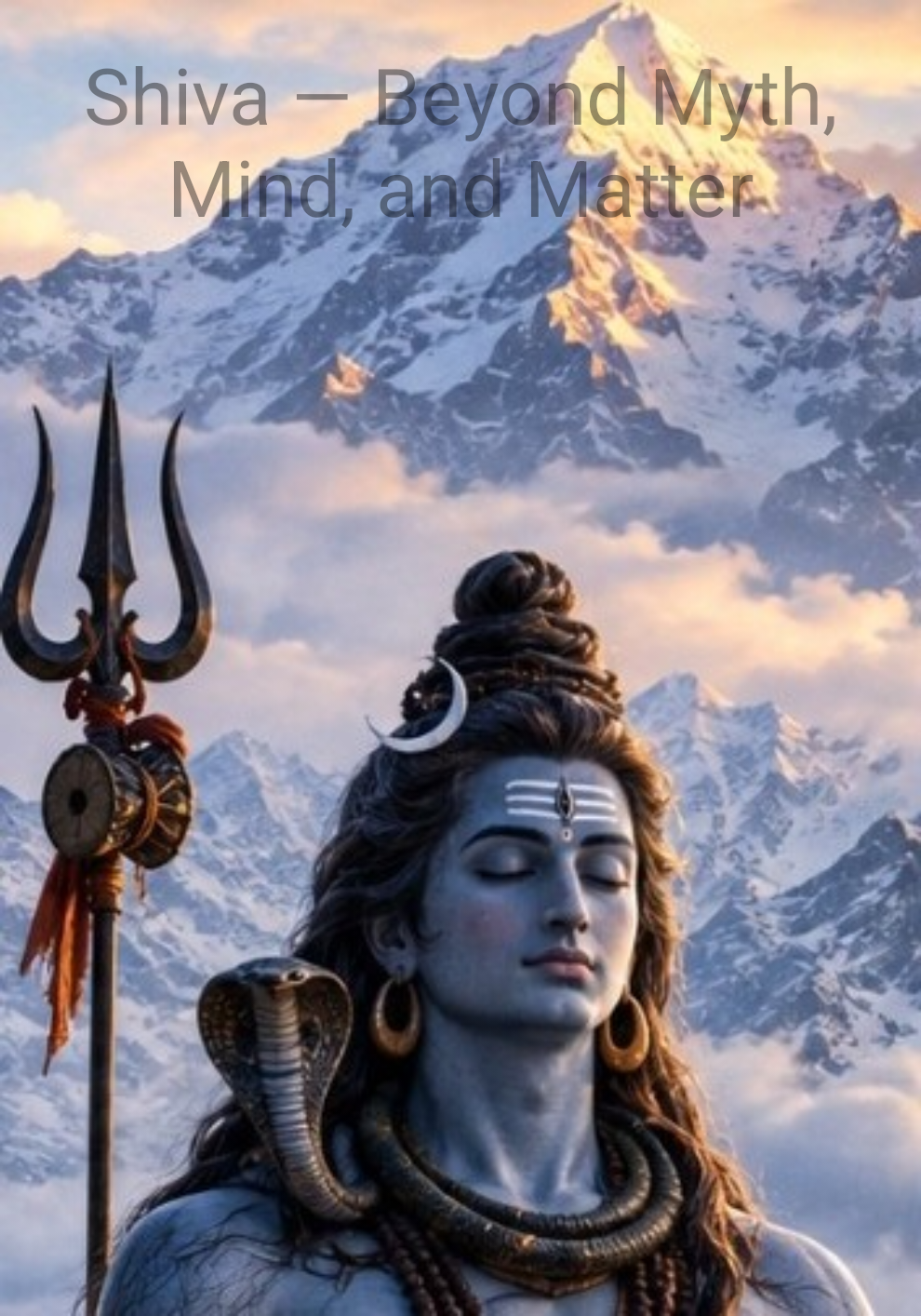
This same science applies to our internal biology. When Shiva sits in deep meditation on Kailash, he represents what neurobiology calls the Alpha and Theta brainwave states—deep, unshakeable inner calm where stress dissolves and the nervous system resets. The Trinetra (Third Eye) corresponds to inner awareness and the pineal gland, which, when activated through deep focus, burns down Kama—the toxic illusions, obsessive desires, and false perceptions of the world. Meanwhile, the flow of the sacred rivers and serpents mirrors the Kundalini energy moving through the three primary nervous channels: Ida, Pingala, and Sushumna.