Library

 Profile
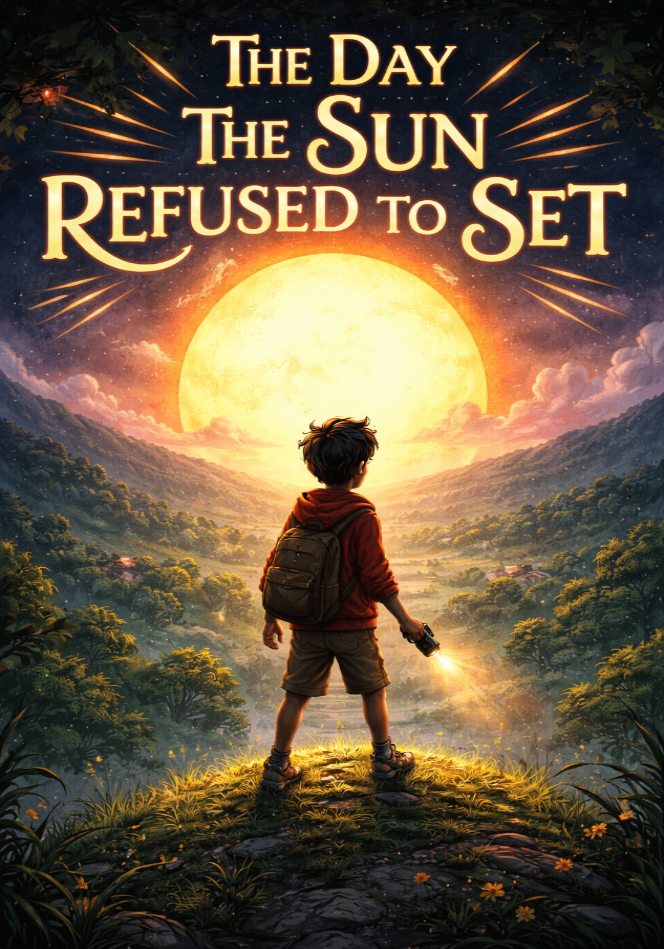
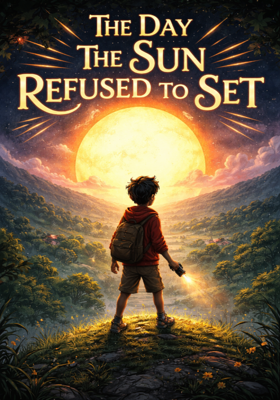
The Day the Sun Refused to Set
The Day the Sun Refused to Set

The sun was not supposed to stay.
Everyone in Sundar Valley knew that.
It rose over the hills each morning like a giant golden coin and disappeared every evening behind the forest cliffs, right when the lamps in town flickered awake.
That was the rule.
And in Sundar Valley, rules mattered.
So when the sun didn’t set on the first day of May, people noticed.
By the second day, they were afraid.
By the third day, the town clock stopped ticking entirely.
---
Twelve-year-old Kabir noticed it before anyone else.
Not the sun.
The shadows.
They had stopped moving.
Usually, by evening, the shadow of the banyan tree outside his window stretched all the way across the street. But now it stayed frozen in the same place, stiff as spilled ink.
Kabir poked his head outside.
The sky glowed orange—not bright like noon, not soft like sunset.
Stuck somewhere in between.
Like the day couldn’t decide whether to end.
His grandmother sat on the porch, staring upward.
“That’s not right,” she murmured.
Kabir frowned. “Maybe it’s summer?”
His grandmother gave him a look.
“Summer is late sunsets,” she said. “This is something else.”
---
At school, nobody paid attention to math.
Everyone kept glancing out the windows.
Birds circled strangely in the sky, confused and restless. Street dogs slept at odd hours. Flowers that bloomed at night remained tightly shut.
Even the teachers looked tired.
By what should have been nighttime, children were still awake across the valley, unable to sleep under the endless amber glow.
Parents whispered.
Shopkeepers argued.
The town priest declared it a warning.
Kabir just felt… uneasy.
Like the world had forgotten how to breathe.
---
On the fourth day, the dreams began.
Kabir dreamed of a giant clock buried beneath the hills.
Its hands were broken.
And beside it stood a girl made of sunlight.
“Find the missing hour,” she whispered.
Then the dream dissolved into blinding gold.
---
Kabir woke sweating.
Outside, the same endless evening glared through his curtains.
He pulled on his sandals and ran to the old library near the river.
If anyone knew anything strange about Sundar Valley, it was Mrs. D’Mello.
The librarian looked unsurprised when Kabir burst through the door.
“You’ve seen her too,” she said quietly.
Kabir froze. “The sunlight girl?”
Mrs. D’Mello nodded.
Then she locked the front door.
---
The library basement smelled like dust and rain.
Mrs. D’Mello lit a lantern, though the world outside was still bright.
“Long ago,” she began, “Sundar Valley kept time differently.”
Kabir blinked. “Differently how?”
“There used to be a Keeper of Hours,” she said. “Someone who protected the balance between day and night.”
“That sounds made up.”
“So does a sun that refuses to set.”
Fair point.
Mrs. D’Mello opened an ancient book filled with drawings of clocks, moons, and strange symbols.
“At the center of the valley,” she continued, “there is an Hour Heart. A magical clock hidden beneath the hills. It turns time forward.”
Kabir leaned closer.
“And if it stops?”
Mrs. D’Mello looked toward the glowing basement window.
“Time gets stuck.”
---
That night—or what everyone called night now—Kabir returned home with the old map Mrs. D’Mello had given him.
A path wound through the forest toward Blackstone Hill.
At the bottom, someone had written:
When the missing hour is returned, the sun will rest again.
Kabir swallowed.
“Easy,” he muttered nervously. “Just return an hour. Totally normal thing to do.”
---
The forest felt wrong under endless daylight.
Owls sat awake in silence.
Crickets refused to sing.
The deeper Kabir walked, the quieter the world became.
Then—
“You came.”
Kabir spun around.
The sunlight girl stood behind him.
Up close, she looked almost real—except light spilled gently from her skin, and her hair floated like it was underwater.
Kabir’s throat tightened. “Who are you?”
“I’m Sol,” she said. “The last Keeper.”
“You’re the girl from my dream.”
“You’re late,” she replied.
Kabir frowned. “Late for what?”
Sol pointed toward Blackstone Hill.
“For fixing time.”
---
Inside the hill, hidden behind twisted roots and stone, they found the clock.
It was enormous.
Bigger than a house.
Golden gears filled the cavern walls, frozen in place.
And right in the center—
A gap.
One empty space where a glowing piece should have been.
“The missing hour,” Sol said softly.
Kabir stared. “Someone stole time?”
“In a way.”
He looked at her. “Who?”
Sol didn’t answer immediately.
Then—
“The valley did.”
---
Kabir blinked. “What?”
“Years ago,” Sol explained, “the people of Sundar Valley wished for longer days. More time to work. More time to succeed. More time for everything.”
The giant clock groaned softly around them.
“They stopped resting,” Sol continued. “Stopped watching sunsets. Stopped listening to night.”
Kabir thought about the town lately.
The tired teachers.
The restless animals.
The sleepless children.
“And the clock broke?” he whispered.
“No,” Sol said sadly. “It obeyed.”
---
The missing hour floated above the clock suddenly—a tiny orb of silver light.
Beautiful.
Fragile.
Kabir reached toward it.
But stopped.
“What happens if I put it back?”
Sol looked at him carefully.
“The sun will set again.”
“That’s good.”
“Yes,” she said. “But people will lose the extra time they wanted.”
Kabir almost laughed.
Extra time?
Nobody looked happy.
The valley felt exhausted.
Like a story stretched too far.
---
He took the glowing hour gently in his hands.
It felt cool.
Quiet.
Like bedtime stories and cricket songs and sleepy evenings.
Things the valley had forgotten.
Kabir climbed the giant clock carefully.
The gears trembled beneath him.
Below, Sol watched silently.
He placed the missing hour into the empty space.
For one terrifying second—
Nothing happened.
Then the clock moved.
A deep, thunderous tick echoed through the cavern.
The gears roared alive.
Dust exploded into the air.
And somewhere above the hill—
The sky changed.
---
Kabir ran outside.
The endless orange glow finally softened.
Dark blue spread slowly across the sky like spilled paint.
Stars blinked awake one by one.
The entire valley fell silent.
Watching.
Waiting.
Then—
The sun set.
---
For the first time in seven days, night arrived.
Real night.
Cool air swept through the trees.
Crickets sang wildly.
People stepped out of their homes, staring upward as darkness wrapped gently around the valley.
Not frightening.
Comforting.
Like the world had finally exhaled.
---
Kabir turned toward Sol.
But she was fading now, her glowing edges dissolving into starlight.
“Wait,” he said quickly. “Will I see you again?”
Sol smiled faintly.
“Only when time is forgotten.”
And then she vanished.
---
The next morning, Sundar Valley woke slowly.
Peacefully.
People moved quieter somehow.
Kinder.
The bakery opened late.
Teachers canceled homework.
Families sat outside together just to watch the evening arrive again.
And every sunset after that felt important.
Like something precious returned.
Kabir still visited Blackstone Hill sometimes.
Just to listen.
Because if the wind was very still, and the valley remembered to rest—
You could hear it.
Tick.
Tick.
Tick.
The sound of time moving properly once more.