Library

 Profile
My superpower
My superpower

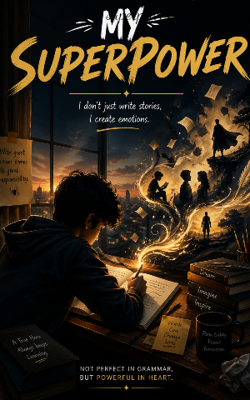
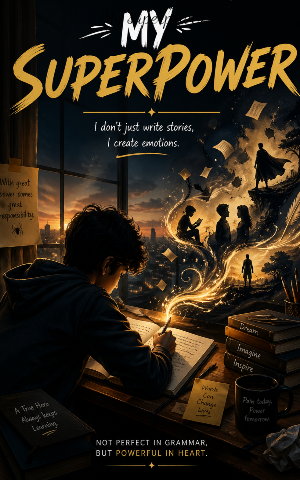
My superpower is that I can write stories that are deep and full of emotion. Whenever I pick up a pen, I feel like I can create a world where people can feel pain, happiness, fear, and hope—all through my words. But there is a famous quote: with great power comes great responsibility. I believe this applies to me as well.
So I need to take my responsibility seriously by writing stories that carry meaningful moral messages. Stories are not just for entertainment; they can change the way people think and feel. A good story can teach someone a lesson, inspire them, or even make them reflect on their own life. That is why I don’t want to waste my ability. I want my stories to have depth and purpose.
But like every superhero, I have a weakness—my grammar. Since childhood, I have struggled with it. No matter how strong my ideas are, I sometimes fail to express them correctly. This has always been frustrating for me. Still, I never gave up. I always told myself, “Even if my grammar is weak, I will write stories that make my teacher cry.” For me, emotions were more important than perfection.
However, there was an incident where I felt like I couldn’t continue anymore.
Once, during a school exam, we were asked to write an essay about being stuck in a city mall. The moment I read the question, I felt shocked and confused. It wasn’t the type of topic where I could easily write a deep emotional story. There was no tragedy, no strong emotional conflict—just a simple situation. My mind went blank.
I put my pen down on the table and stared at the question paper. I could feel my eyes filling with tears. In our school, the essay carries 40 marks out of 80. That means half of the exam depended on this one question. At that moment, I thought I was finished. All my confidence disappeared, and I felt like my “superpower” was useless.
For a few seconds, I almost gave up completely.
But then, a thought came into my mind. I remembered Spider-Man—a superhero who faces countless attacks from powerful villains, yet he never gives up. Even when he is tired, injured, or afraid, he still stands and fights. He doesn’t quit just because things become difficult.
That moment changed something inside me.
I thought, “If he can stand after everything he faces, why can’t I?” I realized that this was my battle. Not against villains, but against my own fear and weakness. So, like him, I decided I would stand too.
I picked up my pen again.
This time, instead of focusing on what I couldn’t do, I used the full power of my imagination. I turned the simple topic into something more engaging. I imagined being alone in a crowded mall, slowly feeling lost, observing people, creating small emotional moments within the situation. I tried to add depth wherever I could, even if the topic was simple.
I wrote continuously, without stopping, putting all my effort into it.
When the exam ended, I felt a mix of relief and uncertainty. I didn’t know whether my answer was correct or completely wrong. But at least I knew one thing—I didn’t give up.
However, the result was not what I expected.
In class, my teacher shouted at me for making the essay too emotional and not matching the topic properly. At first, I felt hurt and embarrassed. It felt like all my effort had gone to waste. But after some time, I understood something important.
I realized that my teacher was not completely wrong.
Writing with emotion is my strength, but writing according to the question is also important. A true writer—and a true hero—must know how to balance both. Just like a superhero must control their powers, I also need to control my writing.
That day, I learned a valuable lesson.
Being strong is not just about having power; it is also about using it correctly. And a true hero does not stop after one failure—they learn, improve, and come back stronger.
So I will keep writing.
Not just emotional stories, but better stories—with meaning, control, and improvement. Because my journey is not over yet, and I am still learning to become the hero of my own story.