Library

 Profile
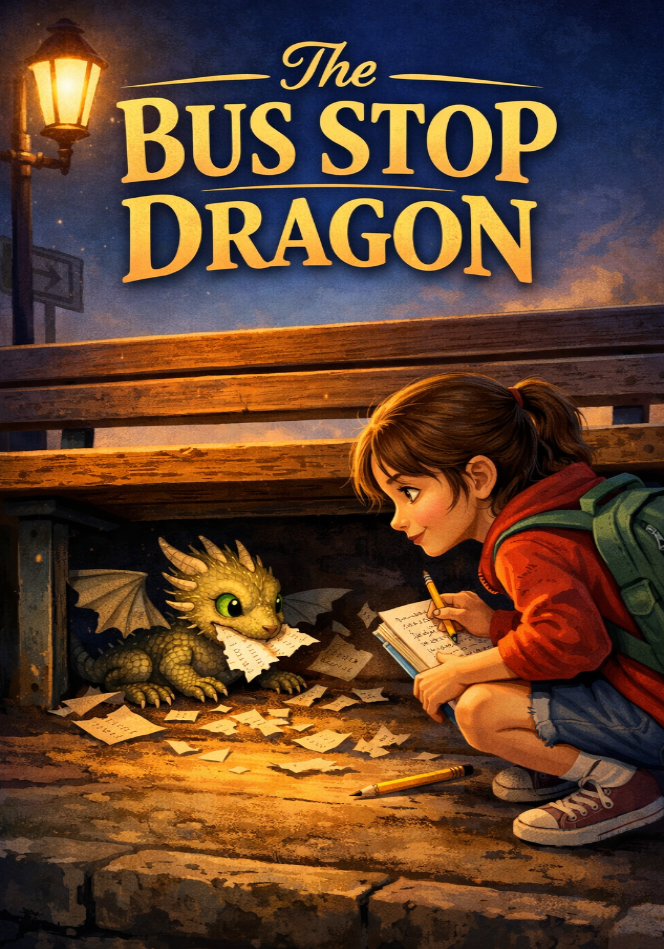
The Bus Stop Dragon
The Bus Stop Dragon

At the far end of Maple Street, where the pavement cracked like a dry riverbed, there was a bus stop no one liked to wait at.
It wasn’t broken. The sign still stood straight, the schedule was mostly accurate, and the bench—though old—didn’t wobble. But something about it felt… off. Kids said the shadows stayed too long there, even in the afternoon. Grown-ups said nothing at all, which was worse.
Only Mira liked that bus stop.
Not because it was creepy. Mira didn’t believe in creepy things.
She believed in patterns.
And lately, something strange had been happening.
Her homework kept disappearing.
Not all of it—just the unfinished parts. Half-done math worksheets. Essays missing their last paragraph. Science questions she’d skipped because they were too hard.
At first, she thought she’d lost them. Then she thought her little brother was stealing them to be annoying.
But then one morning, she found her crumpled math page tucked neatly into her backpack again… except the problems she had skipped were gone.
Not solved.
Gone.
That was when Mira started paying attention.
—
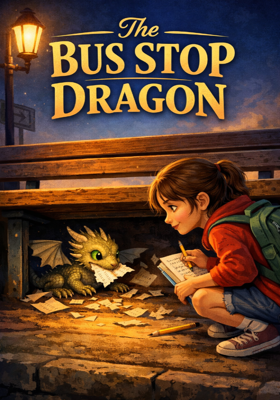
The bus stop bench had a gap underneath it, where the wood slats didn’t quite meet the metal frame. Most people wouldn’t notice it.
Mira did.
She noticed other things, too. Like how the air felt warmer right there, even in the morning chill. Like how her papers rustled sometimes when there was no wind.
And most importantly—how crumbs appeared.
Not food crumbs.
Paper crumbs.
Tiny, jagged pieces, like something had been chewing.
Mira crouched beside the bench, heart thumping. “Hello?” she whispered.
Nothing.
She leaned closer, pressing her cheek almost to the ground.
“That’s where you went, didn’t you?” she said softly. “My homework.”
A pause.
Then—
A faint, papery crunch.
Mira didn’t scream. She didn’t run.
She smiled.
“I knew it.”
—
The dragon was smaller than she expected.
When it finally poked its head out—slowly, cautiously—it was no bigger than a loaf of bread. Its scales shimmered faintly, like pencil shavings catching the light, and its wings looked like folded notebook paper.
Its eyes, though, were bright and sharp.
And guilty.
“You ate it,” Mira said.
The dragon froze.
“You ate my homework.”
The dragon blinked.
Then, very slowly, it nodded.
Mira sat cross-legged on the pavement. “Why?”
The dragon tilted its head, then opened its mouth.
A puff of ash drifted out.
Not fire.
Ash.
Soft, gray, and filled with tiny black flecks—like erased pencil marks.
“You don’t eat finished homework,” Mira guessed.
The dragon shook its head.
“Only unfinished?”
A nod.
“Why?”
The dragon hesitated. Then it shuffled forward, claws clicking softly, and nudged a scrap of paper toward her.
It was one of hers—a piece of her science worksheet.
The part she hadn’t done.
The dragon tapped it, then made a soft, unhappy noise.
Mira frowned. “You don’t like it?”
The dragon shook its head more firmly this time.
“It’s… bad?”
A pause.
Then the dragon puffed out a tiny cloud of ash again.
Mira stared at it.
“You eat the unfinished parts because they’re… wrong?”
The dragon perked up.
“Yes. That had to be it.
Mira’s stomach twisted. “So you’re fixing it?”
The dragon looked uncertain, then gave a small shrug.
“You’re just… getting rid of it.”
Another nod.
Mira sat back, thinking.
That explained a lot.
Her missing work. The way the incomplete parts vanished. Even the strange feeling she’d had lately—like something was quietly erasing her mistakes before anyone else could see them.
It should have felt like a good thing.
It didn’t.
“That’s not helping,” she said.
The dragon’s wings drooped.
“It’s cheating,” Mira added.
The dragon flinched.
Mira sighed. “Not cheating like… on purpose. But still.” She picked up the scrap of paper. “If I don’t finish it, I’m supposed to learn how. That’s the point.”
The dragon looked at her, eyes wide and confused.
Mira softened. “You think you’re helping, don’t you?”
A small, hopeful nod.
“But you’re not,” she said gently. “You’re just making the problem disappear.”
The dragon curled its tail around itself, shrinking a little.
Mira hesitated.
Then she did something surprising—even to herself.
“Hey,” she said. “What if we tried something else?”
The dragon peeked up.
“What if,” Mira continued, “you didn’t eat it right away?”
The dragon blinked.
“You could… wait. And I’ll try to finish it. And if I really can’t—if I get stuck—then maybe you can help.”
The dragon tilted its head.
“Not by eating it,” Mira said quickly. “But… I don’t know. Maybe you can tell me which parts are wrong? You seem good at that.”
The dragon considered this.
Then it slowly, carefully nodded.
—
The next day, Mira brought her math homework to the bus stop.
She didn’t hide it.
She didn’t rush through it either.
She sat on the bench, feet swinging, and worked.
When she got stuck, she tapped the page twice.
A moment later, the dragon’s head appeared.
It sniffed the paper, then gently nudged one of the problems.
“This one?” Mira asked.
The dragon nodded.
Mira frowned at it, thinking.
She erased her answer and tried again.
The dragon watched closely, its tail flicking.
When she finished, it leaned in, inspecting.
Then—
It didn’t eat it.
Instead, it made a soft, pleased chirp.
Mira grinned.
“See?” she said. “Better.”
—
They fell into a routine after that.
Mornings at the bus stop became something Mira looked forward to. She’d bring her homework, and the dragon would help—not by fixing things, but by pointing, nudging, waiting.
Sometimes it got impatient. Sometimes Mira did.
Sometimes she wanted the easy way out—to let the dragon just eat the hard parts and be done with it.
But she didn’t.
And the dragon didn’t either.
Mostly.
—
One afternoon, though, everything went wrong.
Mira had a big assignment due the next day—a report she hadn’t started until that morning.
She sat at the bus stop, staring at the blank page, her chest tight.
“I can’t do this,” she muttered.
The dragon peeked out.
“It’s too much,” Mira said. “I don’t even know where to start.”
The dragon nudged the paper.
“No,” Mira said sharply. “Not this time.”
The dragon froze.
“Just… take it,” she said, pushing the paper toward it. “Please.”
The dragon hesitated.
Then, slowly, it reached out.
Mira watched as it pulled the page closer.
Watched as it opened its mouth.
Watched as the edges began to curl and crumble into ash.
Her stomach dropped.
“Wait,” she said.
The dragon paused.
Mira swallowed. “Don’t.”
The dragon looked at her.
Mira took a shaky breath. “If you eat it… I’ll never learn how to do it.”
The dragon’s mouth closed.
The paper, singed at the edges, lay between them.
For a long moment, neither of them moved.
Then Mira reached out and pulled it back.
“Help me,” she said quietly.
The dragon nodded.
—
The report wasn’t perfect.
Mira knew that when she handed it in the next day. There were parts she still didn’t understand, sentences that felt clumsy, ideas that didn’t quite connect.
But it was hers.
Every messy, unfinished piece of it.
And when she sat at the bus stop that afternoon, the dragon curled up beside her—not under the bench this time, but out in the open, just a little.
“You didn’t eat it,” Mira said.
The dragon shook its head.
“Even though it wasn’t perfect.”
A pause.
Then the dragon made a small, thoughtful sound.
Mira smiled.
“Yeah,” she said. “I think that’s the point.”
The bus rumbled in the distance.
Mira stood, slinging her bag over her shoulder.
“See you tomorrow?”
The dragon nodded.
As the bus pulled up, Mira glanced back once more.
The bench looked the same as always—old, quiet, a little strange.
But underneath it, something had changed.
Not everything unfinished needed to disappear.
Some things just needed time.