Library

 Profile
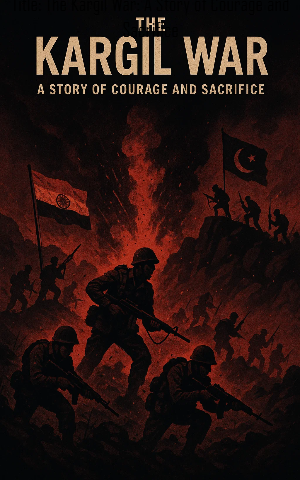
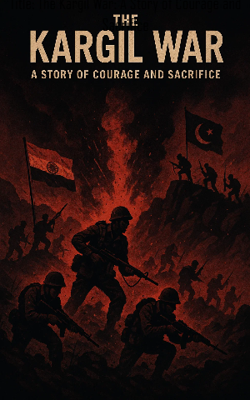
Title: The Kargil War: A Story of Courage and Sacrifice
Title: The Kargil War: A Story of Courage and Sacrifice

Preface
India has always stood tall in the face of adversity. From the time of independence in 1947, the nation has had to defend its integrity, particularly against its neighbor Pakistan. While our hearts long for peace, history has often called upon brave men and women to rise and protect our soil.
For India, peace has never been a sign of weakness. It is a principle rooted deeply in our culture — from the teachings of Buddha to the leadership of Mahatma Gandhi. However, when peace is threatened, the tricolor has always been protected with unmatched resolve. The Kargil War of 1999 was one such defining moment — not just a war for territory, but a battle to defend the soul of a nation.
Before we dive into that tale of valor, let us take a journey through the earlier battles that shaped this enduring rivalry.
Chapter 1: The First Sparks – Indo-Pakistani War of 1947-48
It was the autumn of 1947. India had just gained independence, and so had Pakistan. The princely states were given a choice – to join India, join Pakistan, or remain independent. Jammu and Kashmir, ruled by Maharaja Hari Singh, chose to stay independent. But peace was not to last.
Chapter 2: Thunder in the Valley – Indo-Pakistani War of 1965
Tensions over Kashmir continued to simmer. In 1965, Pakistan launched "Operation Gibraltar" to infiltrate forces into Indian territory. The plan backfired. India responded with full military force. For 17 days, both sides engaged in intense warfare across land and air.
India captured key areas and pushed back the enemy. The war ended with a ceasefire brokered by the Soviet Union and the United States through the Tashkent Agreement. India had once again defended its land, but the peace was temporary.
Chapter 3: A New Nation Is Born – Indo-Pakistani War of 1971
Far away in East Pakistan (now Bangladesh), political and ethnic tensions exploded. India was drawn into the conflict as millions of refugees crossed the border.
In December 1971, India launched a swift and decisive military campaign. Within 13 days, Indian forces aided the liberation of Bangladesh. Over 90,000 Pakistani soldiers were taken as prisoners of war. A new nation was born. India had emerged victorious, but the shadow of conflict with Pakistan remained.
Chapter 4: Intrusion into the Heights – The Kargil War Begins
It was May 1999. The cold winds of Kargil masked the dark secret of an enemy’s plan. Local shepherds noticed unusual movements in the mountains. What they had seen were not just shadows — but soldiers. Pakistani troops and armed militants, disguised as insurgents, had crossed the Line of Control (LoC) and occupied strategic positions along the ridgelines of Kargil, Dras, Batalik, and other sectors.
The enemy had a dangerous advantage — they had set up posts at higher altitudes, overlooking National Highway 1, the vital route connecting Srinagar to Leh. Cutting off this route would isolate Indian forces in Ladakh. The stakes were high. India had to respond — not with hesitation, but with strength.
As the Indian Army began assessing the situation, soldiers discovered that the infiltrators had deeply entrenched themselves in well-fortified bunkers, armed with sophisticated weapons and supported by Pakistan's regular army. The war had begun — not officially declared, but fiercely real.
Chapter 5: The Fire Within – Timeline of the War
3 May: Alert from local shepherds about enemy presence.
5 May: Five Indian soldiers were captured and killed. Indian Army confirmed enemy infiltration.
10–25 May: Pakistan targeted NH-1; India launched Operation Vijay, mobilizing over 200,000 troops.
26 May: Indian Air Force launched Operation Safed Sagar. For the first time since 1971, Indian jets roared through the Himalayan skies, attacking enemy positions at dizzying altitudes.
13 June: Tololing peak was recaptured after weeks of bloody combat. It was a key breakthrough that boosted morale.
4 July: Tiger Hill, towering at over 16,000 feet, fell into Indian hands after a daring midnight assault.
26 July: Complete victory declared. The last of the enemy was driven out. Kargil Vijay Diwas was born.
What stood out in this war was not just victory — but the spirit. Soldiers fought not just against the enemy, but also against nature itself. Bone-chilling winds, thin air, and steep cliffs made every step a challenge. Yet, they marched on — because they were fighting for their motherland.
Chapter 6: The Sons of the Soil – Kargil Heroes
Among the thousands who fought, a few names became legends.
Grenadier Yogendra Singh Yadav scaled a cliff face to destroy enemy bunkers even after being shot thrice.
Captain Vikram Batra, fondly remembered for the slogan “Yeh Dil Maange More,” captured Point 5140 and laid down his life at Point 4875.
Lieutenant Manoj Kumar Pandey led fearless attacks in Batalik, achieving victory before sacrificing his life.
Rifleman Sanjay Kumar charged bunkers alone, despite bullet injuries, and secured enemy positions.
All were awarded the Param Vir Chakra, India's highest gallantry award.
Chapter 7: Warriors with Heart – Mahavir Chakra Awardees
Brave hearts like Captain Anuj Nayyar, Major Padmapani Acharya, and Captain Keishing Clifford Nongrum led daring assaults and made the ultimate sacrifice.
Naik Digendra Kumar, though wounded, continued firing with one hand to cover his team. Major Sonam Wangchuk used his knowledge of terrain to gain a tactical advantage.
These heroes, and many more, were honoured with the Mahavir Chakra for their unmatched courage.
Chapter 8: The Legacy Lives On
The Kargil War was more than a conflict. It was a symbol of Indian resilience, unity, and heroism. Every 26th of July, India celebrates Kargil Vijay Diwas, remembering those who didn’t return but left behind stories of valour.
Monuments like the Dras War Memorial, built at the base of Tololing Hill, stand as silent tributes. Inscribed with the names of the fallen, it reminds every visitor that freedom is never free — it is earned with blood and sacrifice.
Schools across the country hold special assemblies. Children dress as soldiers, sing patriotic songs, and write letters to Army men serving at the borders. The tricolor flutters proudly, and citizens light candles to honor those who gave their today for our tomorrow.
In villages and cities, the families of martyrs are remembered with pride. Mothers, though heavy with grief, speak of their sons with heads held high. Wives who became widows still wear the badge of bravery their husbands left behind. The war might have ended, but its stories continue to inspire generations.
Kargil was not just a military victory — it was a moral victory. It reminded the world that India's courage cannot be tested, and its unity cannot be shaken. Whether in icy peaks or scorching deserts, the Indian soldier will rise — with the Constitution in one hand and a rifle in the other — to defend every inch of this sacred land.
Epilogue
To read about the Kargil War is to walk through a valley of ice, fire, and blood – where every mountain peak echoes with the voice of a soldier. Let this book be a small flame that keeps their memory alive in every Indian heart.
Their names may be etched in stone, but their legacy lives in our souls. Jai Hind. this sacred land.