Library

 Profile
LEADING THE CHANGE
LEADING THE CHANGE

Leading the Change: Women Shaping Sustainable Future
Theme: The Ripple Effect – How Local Leadership Ignites Global Restoration
By Coker Favour A.
They say a ripple begins with something small —
a stone touching water.
But sometimes, the ripple begins with a woman
who refuses to stay silent.
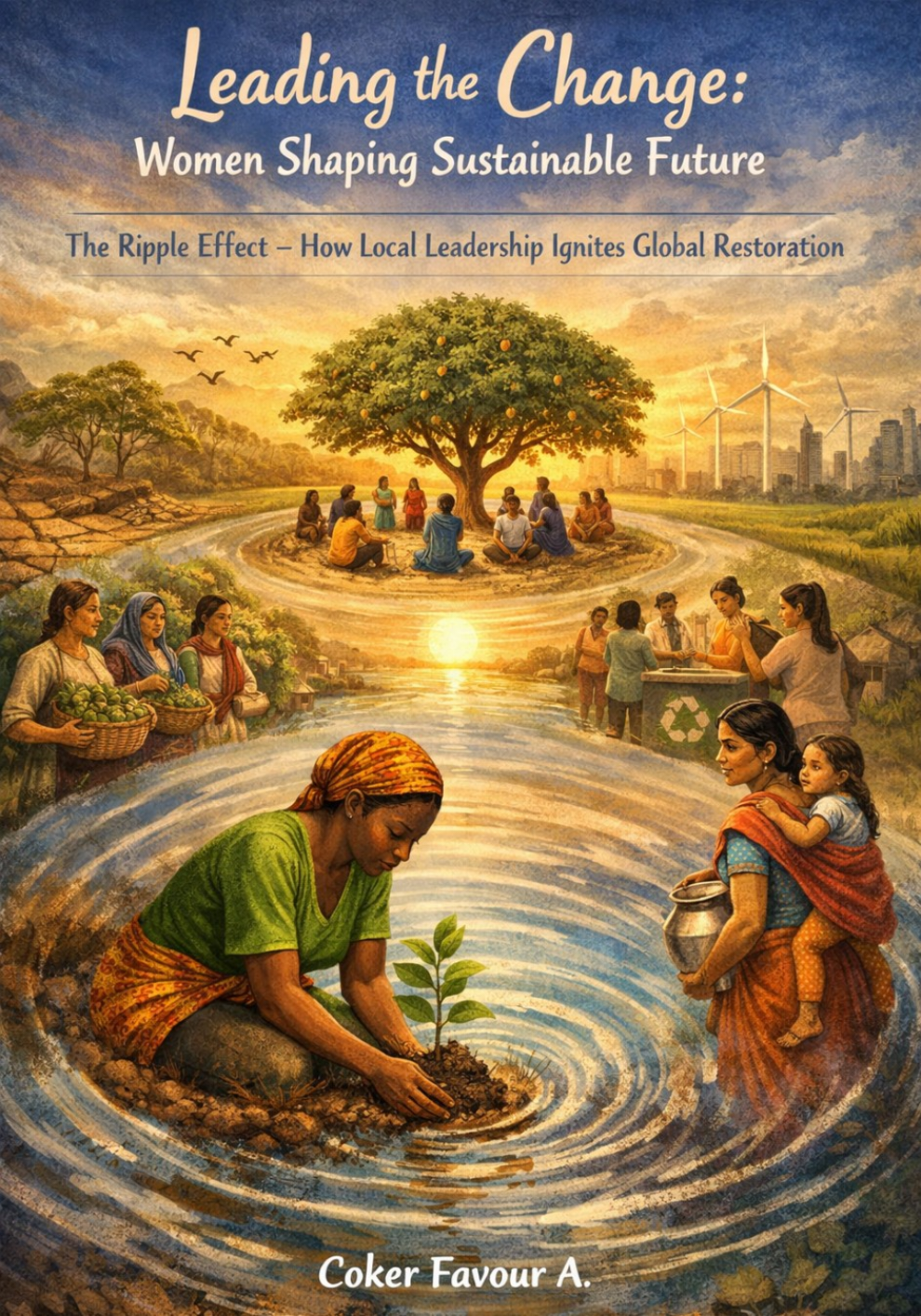
In a small village where the sun burns fiercely and the soil cracks with thirst, a woman plants a tree. She does not plant it for applause. She plants it because she remembers when the river used to sing and the air used to feel kinder. Her act seems ordinary. Almost invisible.
Yet that tree becomes shade.
Shade becomes gathering.
Gathering becomes awareness.
Awareness becomes movement.
This is the ripple effect.
Across the world, women are shaping a sustainable future not from podiums alone, but from kitchens, farms, classrooms, markets, and community halls. They lead climate conversations while carrying children on their backs. They advocate for clean water while managing households. They organize recycling drives, promote organic farming, fight deforestation, and educate the next generation about the Earth’s fragile balance.
Local leadership is powerful because it understands local pain.
A mother who watches her child fall sick from polluted water does not need statistics to fight for change. A farmer who sees crops fail due to erratic rainfall does not need a global summit to understand climate urgency. Their leadership is rooted in lived experience.
And lived experience creates authentic action.
When women lead locally, they build trust. When trust is built, communities listen. When communities listen, habits change. And when habits change, systems begin to shift.
That is how a small meeting under a mango tree becomes a community garden.
That is how a neighborhood clean-up becomes a city-wide sanitation reform.
That is how a local eco-club becomes a national sustainability campaign.
The ripple grows.
In Hinglish we say, “Boond boond se sagar banta hai.”
Drop by drop, an ocean is formed.
Every reusable bag encouraged, every girl educated about environmental science, every policy challenged, every seed planted — these are drops. Women understand the patience of drops. They understand nurturing. They understand continuity.
Sustainability itself is an act of care — and care has always been a language women speak fluently.
But let us be clear: this is not about romanticizing struggle. Women shaping a sustainable future face resistance. They face dismissal, underfunding, and cultural barriers. Yet they persist. Because sustainability is not just about saving the planet — it is about protecting homes, futures, and dignity.
When a woman leads change locally, she is not thinking small. She is thinking generationally.
Her daughter watches.
Her son learns.
Her neighbor joins.
Her community evolves.
And the world shifts — quietly, steadily.
Global restoration does not begin in conference halls alone. It begins in courtyards, in classrooms, in village councils, in urban slums, in grassroots organizations led by women who understand that change must be practical before it becomes political.
The future we hope for — cleaner air, greener cities, responsible consumption, social equity — will not be built only by technology. It will be built by leadership rooted in empathy and action.
And women, through countless local ripples, are proving that restoration is possible.
A ripple is never loud.
It does not roar like a storm.
It moves gently — but it reaches far.
Today, somewhere, a woman is leading change without headlines.
Tomorrow, the world will feel the impact.
Because when she steps forward,
the Earth breathes a little easier.
©® Coker Favour A.